



Silenced Compressors
Silenced Compressors are designed to give you the same powerful performance but with the fraction of the noise associated with standard piston compressors. These Italian-manufactured compressors are an excellent addition to any workshop.
These are also suitable for personal use, tyre shops and larger Fast Fit environments where the installation requires close placement to the workspace, these air compressors offer large air volume where required with the lowest possible noise levels.
Check out our range of Silenced Compressors
Out of stock
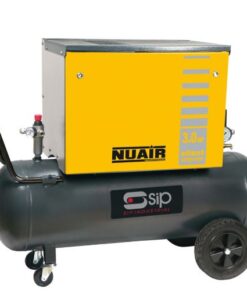
Silenced Compressor
£1,559.99 incl VAT£1,299.99 excl VAT
Out of Stock
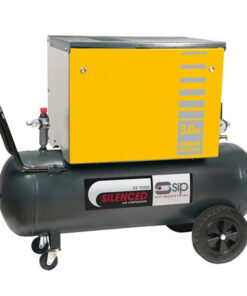
Silenced Compressor
£1,799.99 incl VAT£1,499.99 excl VAT
In Stock
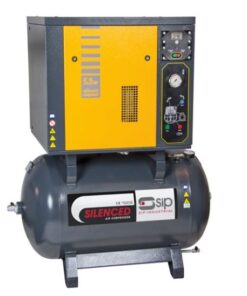
Silenced Compressor
£3,203.99 incl VAT£2,669.99 excl VAT
In Stock
![SIP NB7.5/270 Silenced Compressor [SIP 04208]](https://www.tyrebaydirect.com/wp-content/uploads/2819_360_360-247x296.jpg)
Silenced Compressor
£3,479.99 incl VAT£2,899.99 excl VAT
In Stock
Silenced Compressors Explored
Modern tyre bays, MOT stations, and automotive workshops require reliable pneumatic power without the intrusive, deafening noise of conventional machinery.
High-volume workshops often operate in compact premises where locating an air compressor in a remote plant room is simply not an option.
Silenced compressors solve this challenge by housing robust piston pumps within acoustically engineered, sound-dampened cabinets.
You can browse our full lineup of Italian-manufactured workshop solutions across our dedicated silenced compressors range.
These advanced units deliver full commercial air delivery whilst keeping working environments quiet, comfortable, and fully compliant with workplace health regulations.
How does acoustic attenuation protect technician hearing and reduce fatigue
Prolonged exposure to the low-frequency mechanical thumping of standard piston compressors causes auditory fatigue and permanent hearing impairment.
Standard open-frame compressors regularly generate noise levels exceeding 85 to 95 dB(A), which surpasses UK workplace noise exposure limits.
Silenced compressor systems incorporate heavy-duty acoustic baffling and high-density sound-absorbing foam lining within a sealed steel cabinet.
This structural enclosure dampens mechanical piston slap, air intake roar, and structural vibrations, bringing noise down to between 64 and 69 dB(A).
Technicians can carry out tyre fitting, wheel balancing, and customer handovers right next to the machine without wearing hearing protection or shouting.
Why is cabinet forced air cooling critical for pump longevity
Enclosing an air-cooled piston pump inside an insulated metal box creates serious thermodynamic challenges that must be addressed engineered solutions.
Without active ventilation, heat builds up rapidly inside the enclosure, causing compressor lubricating oil to thin and degrade.
Silenced compressors utilise dedicated internal electric cooling fans and labyrinth airflow pathways to maintain a steady cooling draft.
Fresh ambient air is pulled across the finned cast iron cylinders and copper intercoolers before hot air is vented out through directional exhaust louvres.
This regulated airflow keeps internal operating temperatures low, preventing carbonisation on valve plates and extending piston seal life.
What are the mechanical risks of neglecting condensed water drainage
Water vapour condenses inside the air receiver tank every time atmospheric air is compressed and cooled.
Allowing moisture to accumulate inside the receiver reduces the total volume of air storage available for workshop tools.
More critically, pooled condensation induces internal rust and scale that can flake off into pneumatic delivery pipework.
This grit quickly clogs the sensitive control valves and pneumatic cylinders of automated tyre changers and wheel lifters.
Regular daily manual draining or fitting an automatic timed solenoid drain valve prevents tank corrosion and ensures dry, clean air delivery.
How to Choose the Perfect Silenced Compressor
Selecting the ideal silenced compressor requires balancing your workshop's total pneumatic air demand against your electrical supply setup.
Underestimating your workshop air requirements will cause the pump to run beyond its duty cycle, leading to pressure drops during busy periods.
So what should you consider here?
Begin by calculating your required Free Air Delivery (FAD) in cubic feet per minute (CFM) rather than relying purely on displacement figures.
Displacement indicates the theoretical swept volume of the pistons, whilst FAD reflects the actual usable compressed air supplied at working pressure.
For instance...
A busy tyre bay running two bead-assist tyre changers and 1/2-inch air impact wrenches simultaneously needs at least 12 to 18 CFM FAD.
Next, evaluate the available electrical infrastructure on your premises.
Single-phase 230V units provide high-efficiency output up to 3.0 HP (2.2 kW), making them suitable for smaller garages and fast-fit centres.
Larger facilities with multiple active service bays require three-phase 400V power to drive 5.5 HP or 7.5 HP heavy-duty motor configurations.
Finally, match the receiver tank size (such as 100L, 200L, or 270L) to your peak usage bursts to avoid pressure fluctuations during tyre bead seating.
Variations & Types
Single-Phase 230V vs Three-Phase 400V Silenced Systems
The electrical configuration of your workshop dictates the motor output and air delivery volume you can achieve.
Single-phase 230V silenced compressors are versatile plug-and-play solutions ideal for independent garages and workshops without three-phase supplies.
These units utilise high-torque electric motors paired with single-stage or two-stage pumps, providing up to 13 to 14 CFM displacement.
Three-phase 400V models are built for industrial duty cycles, driving 5.5 HP and 7.5 HP heavy-duty pumps with low current draw per phase.
They feature heavy-duty Star-Delta or Direct-On-Line control boxes that provide smooth motor starts without causing electrical line voltage drops.
Three-phase systems deliver high displacement ratings up to 30 CFM, making them capable of feeding several busy tyre bays simultaneously.
Wheel-Mounted Workshop Units vs Stationary Static Receivers
The layout and portability needs of your workplace determine whether a mobile or stationary compressor is the best fit.
Wheel-mounted silenced units feature heavy-duty wheels, front rubber castors, and sturdy grab handles integrated directly into the tank design.
These mobile units allow technicians to move the machine closer to dedicated workstations or reposition it during workshop reorganisations.
Static receiver-mounted compressors are designed for permanent installation on vibration-absorbing floor mounts.
These units utilise large 200-litre and 270-litre horizontal air receivers that connect directly into rigid workshop air ring mains.
Static units provide an extensive air buffer, ensuring that air pressure remains stable across multiple air drops simultaneously.
Single-Stage vs Two-Stage Silenced Cast Iron Pumps
Internal pump architecture dictates both maximum operational air pressure and overall mechanical efficiency.
Single-stage twin-cylinder pumps compress air to final pressure in one stroke, achieving maximum working pressures of around 145 PSI (10 bar).
They provide smooth performance and lower running costs for standard passenger car tyre inflation and routine light air tools.
Two-stage pumps compress air progressively across two cylinders, using an intermediate finned copper intercooler pipe between stages.
This progressive compression reaches operating pressures up to 160 to 175 PSI (11 to 12 bar) with superior thermal management.
Two-stage configurations are preferred for commercial tyre fitting where high seating pressures are needed for commercial van and 4x4 tyres.
Specialist Considerations
Air Flow Demand Across Tyre Bay Tools
Understanding tool air consumption prevents sudden workshop air starvation during busy operating hours.
Typical pneumatic tyre workshop tools demand varying air volumes:
- 1/2-inch impact wrenches consume between 4 and 8 CFM during wheel removal.
- 3/4-inch and 1-inch commercial tyre guns draw 12 to 18 CFM under heavy load.
- Pneumatic tyre changers with dual bead-assist arms need an immediate 8 to 12 CFM buffer.
- Continuous air tools such as high-speed tyre buffers require a steady 10 to 15 CFM without interruption.
Choosing a silenced compressor with an adequate CFM margin ensures you maintain working pressure without over-working the pump.
Integrated Diagnostic Gauges and Control Panels
Modern silenced compressors incorporate user-friendly external control fascias directly into the front acoustic cabinet panel.
Technicians can easily monitor line pressure, tank pressure, and total operating hours without having to open the acoustic housing.
The integrated hour meter provides accurate tracking for scheduled service intervals, including oil changes and belt inspections.
High-visibility pressure regulators allow immediate adjustment of delivery pressure to suit delicate tools or heavy-duty inflation tasks.
Emergency stop switches and thermal motor overload cut-outs are accessible instantly to protect both operators and internal machinery.
Vibration Isolation and Workplace Positioning
Although silenced cabinets suppress airborne acoustic noise, reciprocating pumps still produce mechanical vibrations that can resonate through flooring.
Silenced compressors feature internal rubber damper mounts between the pump baseplate, electric motor, and the main storage receiver.
This dual-isolation setup stops harmonic vibration from transferring into the external cabinet shell or the concrete workshop floor.
When installing a static unit, ensure at least 50 cm of clearance around all sides to allow unrestricted cooling air intake and exhaust circulation.
Proper positioning guarantees optimum cooling airflow whilst keeping the unit easily accessible for routine fluid checks.
Quality & Brand Selection
Investing in silenced compressor machinery from established, industry-leading manufacturers guarantees reliable daily operation and straightforward parts support.
Renowned engineering brands such as SIP and Airmate lead the industry with Italian-manufactured silenced compressor ranges built for rigorous garage use.
These systems feature precision-machined cast iron cylinder blocks, dynamically balanced flywheels, and durable Swedish stainless steel reed valves.
Their premium acoustic cabinets provide industrial-grade sound dampening without compromising thermal performance or operational access.
Furthermore, all certified air receivers conform strictly to UKCA and CE pressure vessel regulations for maximum peace of mind.
Explore our complete lineup of professional low-noise workshop machinery in our silenced compressors collection to equip your business with the quiet power it needs.
Read our great
customer reviews
Great after sales service...
I had an issue with the tyre changer, rang for help, got a video call back within minutes and then received a live walk through the problem talking me through the actions required to rectify.
I also enquired about operating instructions for the balancer as I was struggling to understand some of the written ones. I then got a live training session on the video call followed up with a link to a training video in a message.
Excellent after sales service from Neal.
Great customer service and responsive...
Great customer service and responsiveness. I was dealing with a gentleman named Neal, who was very responsive to my phone calls, answered all my questions, and provided me with solutions. I would definitely recommend him to anyone and will use his excellent service in the future. Keep up the good work, guys.
Quality of service...
Anthony has now dealt with my orders on 2 occasions, very helpful and polite and noticed our previous order ... can’t recommend more he knows his equipment from the conversation had, haven’t needed to use the “help or after service” but certainly wouldn’t think twice of doing with how Anthony has dealt with anything we asked from enquiry to buying. Top class service delivery over Xmas 2019 was as agreed and the delivery driver was top class in rush hour so made him a brew minus the bacon butty as we had none left!! Give the guys a pay rise but price increase.
Thanks again look forward to purchasing from you soon. 100% service from start to end.